AI Employee vs AI Chatbot: The Distinction That Changes Everything
The confusion between an AI employee and an AI chatbot is not a minor semantic debate. It is the difference between deploying software that transforms how your organisation operates versus buying a product that generates text responses your team largely ignores after the first month. Understanding the AI employee vs AI chatbot distinction is the single most important conceptual step an enterprise buyer can take before any AI procurement decision.
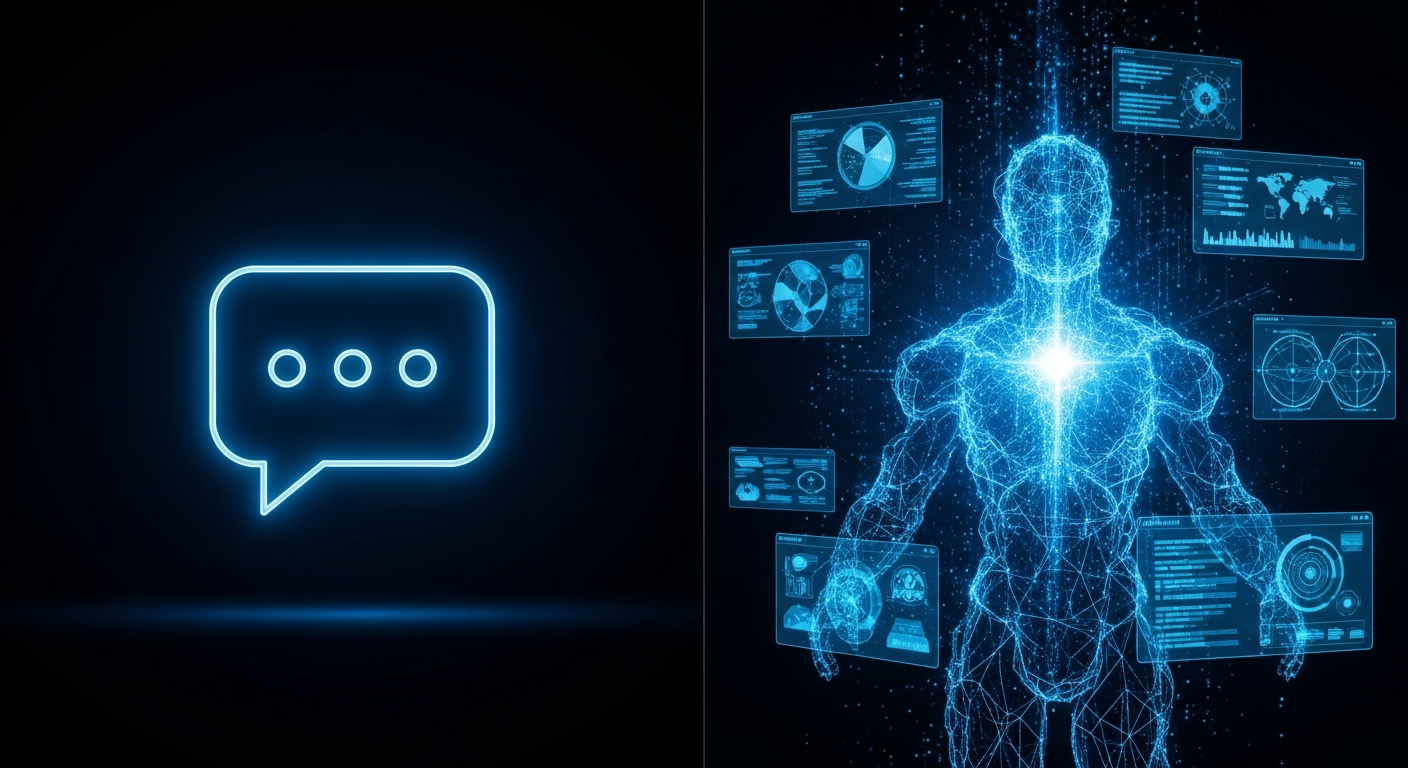
The short version: a chatbot answers questions. An AI employee takes actions. One produces words. The other produces outcomes.
What a Chatbot Does (and Why It Falls Short)
A traditional enterprise chatbot — whether built on Dialogflow, Botpress, or Microsoft Bot Framework — operates as a sophisticated FAQ system. It receives a user message, matches it against a knowledge base or decision tree, and returns a text response.
But a chatbot has fundamental architectural constraints. It has no persistent memory — each conversation starts fresh. It has no tool access — it cannot call external APIs, read from databases, or execute code. It takes no actions — every response it generates is text that a human must then act upon.
According to Gartner's research on conversational AI, the average enterprise chatbot achieves 20-30% deflection on simple queries and near zero deflection on anything requiring system access.
What an AI Employee Does Differently
An AI IT support employee that receives a VPN connectivity ticket does the following: authenticates to your identity provider, queries your network monitoring tool for VPN server health, checks the user's device compliance status, identifies the root cause, takes the remediation action, updates the ITSM ticket, and notifies the user. This entire sequence happens in seconds, without human involvement.
The architectural properties that make this possible:
Persistent memory. An AI employee remembers every interaction with every user. A chatbot starts every conversation blank.
Tool access. An AI employee operates a comprehensive toolkit: shell command execution, browser automation, API calls, database reads and writes, and message sending across any enterprise channel.
Multi-step reasoning. An AI employee plans and executes multi-step workflows. When the first remediation step fails, it tries the next. When it hits an edge case, it escalates with full context.
Role boundaries. An AI employee operates within explicitly defined boundaries — what it can do autonomously, what requires human approval, and what it never does. These boundaries are enforced at the code level.
Why the Distinction Matters for Indian Enterprise Buyers
India's enterprise AI market has been flooded with chatbot products repositioned as 'AI agents' or 'AI employees.' The test is simple: can the AI employee you're evaluating demonstrate end-to-end resolution of an IT ticket in your actual enterprise systems? Not a prototype. In your Jira, against your identity provider, with your user's actual ticket.
TechCrunch's coverage of the agentic AI category in 2026 has consistently noted that the gap between AI agent marketing claims and actual enterprise capabilities is the defining trust problem in the category.
Five Questions to Ask Any AI Employee Vendor
First: can it show a complete end-to-end workflow execution trace showing every system action taken? Second: what tool integrations exist — native or webhook-based wrappers? Third: what happens at edge cases — fail, hallucinate, or escalate intelligently? Fourth: where does inference happen — your infrastructure or an external API? Fifth: what are the human approval boundaries — code-enforced, not policy statements?
An AI employee built on OpenClaw answers all five questions concretely. The execution trace is the OpenClaw session log. Integration is native. Edge case handling is built into the SOUL.md escalation logic. Inference runs on NemoClaw within your infrastructure.
For more on agentic AI architecture, read Agentic AI Explained. To see what roles are available, visit agentex.in/hire.
Book a discovery call to see an AI employee execute a live workflow in your enterprise systems.
Topics
Ready to deploy?
Book an AI Deployment Sprint — one workflow, live in 2 weeks.
Book AI Deployment Sprint →