Why Indian HR Onboarding Is Broken (And What Fixes It)
Every Indian enterprise above 50 employees has the same HR onboarding problem, and almost every enterprise has tried to solve it the same way: build a portal. Document everything. Put FAQs on the intranet. Create an onboarding checklist in Notion or Confluence. Train new joinees to use it.
Then watch 40% of new joinees still call HR for help on their first day because the portal doesn't answer their actual question. Watch HR teams spend 30% of their bandwidth on onboarding queries that should have been self-serve. Watch the HRMS not get updated because the HR coordinator forgot to log the completion status. Watch IT provisioning take three days because the request got lost in email.
This is not a portal quality problem. It is a fundamental limitation of passive information systems in the face of active human questions. A portal can only answer the questions it was designed for. An AI HR employee answers every question — including the one the portal author didn't anticipate.
What an AI HR Onboarding Employee Does
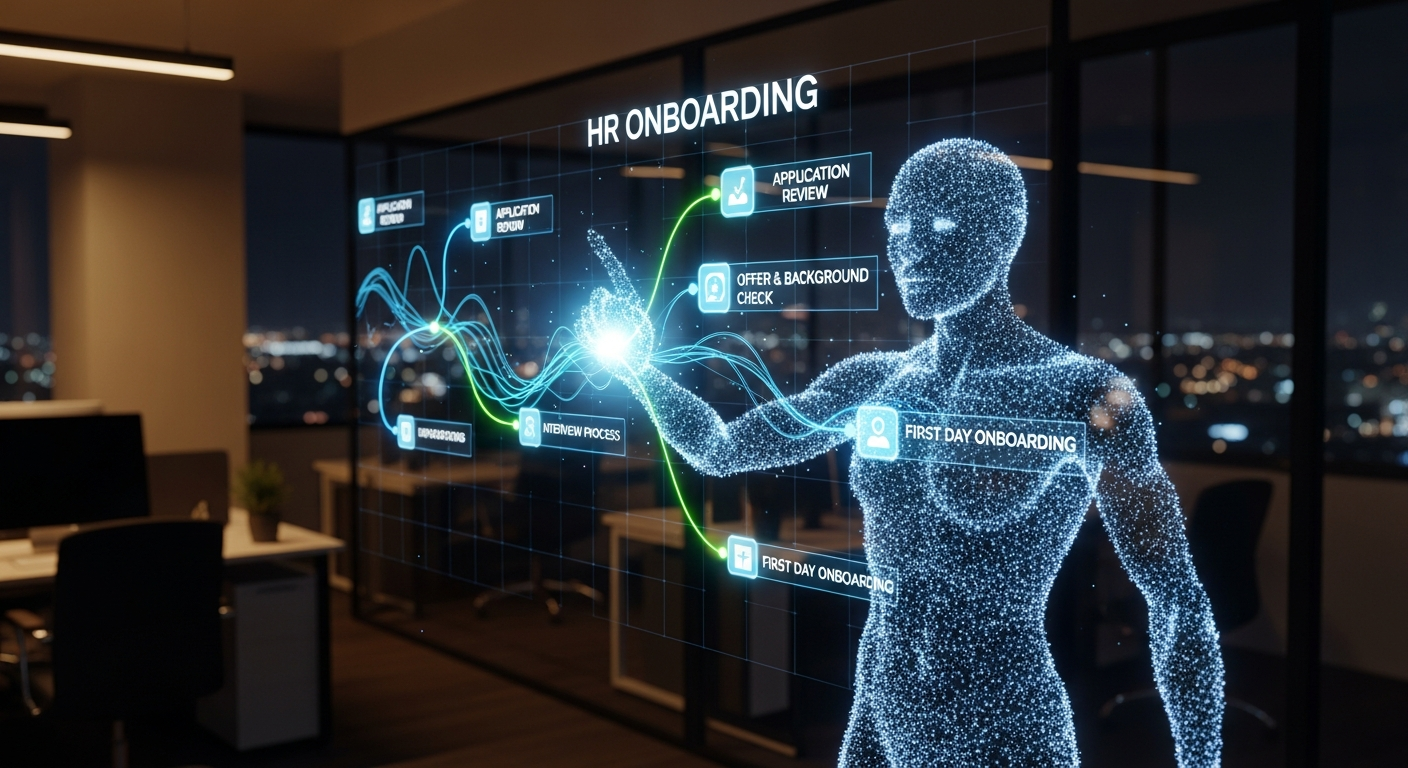
An AI HR onboarding employee deployed on OpenClaw integrates with your HRMS (Keka, Darwinbox, or GreytHR), your IT provisioning system (Active Directory or Okta), your document management system, and your enterprise messaging channels (Slack or WhatsApp).
When a new joinee has a question — about leave policy, reimbursement process, IT access, probation terms, health insurance enrollment, or any of the 40+ most common onboarding queries — the AI HR employee answers it instantly, in natural language, based on your actual current policy. Not a FAQ document. Not a Notion page. A direct, accurate, conversational answer that addresses the specific question asked.
Beyond answering questions, the AI HR employee takes actions. When the joinee confirms their IT access requirements, the AI HR employee raises the provisioning ticket in your ITSM automatically. When joining documents are submitted, the AI HR employee updates the record in Keka or Darwinbox. When the 30-day check-in milestone arrives, the AI HR employee sends the check-in message, collects the feedback, and logs the response.
According to Darwinbox's HR technology benchmark research, Indian enterprises that automate onboarding communications reduce new hire time-to-productivity by 15-25%. The mechanism is simple: a new employee who has their questions answered instantly and their access provisioned on day one is productive faster than one who spends their first week waiting for responses.
The Keka and Darwinbox Integration Story
Two HRMS platforms dominate the Indian mid-market enterprise segment: Keka HR and Darwinbox. Both provide REST API access that OpenClaw uses for direct integration. The AI HR employee can read employee records, write onboarding status updates, trigger approval workflows, and query leave balances from both platforms.
The integration patterns are native — not webhook wrappers that break when the HRMS provider updates their API schema. OpenClaw's Keka and Darwinbox connectors are maintained by the active open-source community and updated for API changes as they occur. This is a meaningful advantage over custom webhook integrations, which are often built once and left unmanaged until they break.
The most valuable Keka integration from an HR operations standpoint: the automatic HRMS update when onboarding milestones complete. When the AI HR employee confirms that a new joinee has completed their policy acknowledgment, submitted their joining documents, and received their IT access, it updates the onboarding checklist in Keka automatically. HR can see real-time onboarding status across all active joiners without manually updating records.
The Policy Accuracy Problem and How It Is Solved
The first objection every HR leader raises about AI HR employees is accuracy: what if the AI gives wrong policy information? This concern is valid — giving a new employee incorrect information about their leave entitlement or probation terms is a real problem.
The solution is how the AI HR employee's knowledge base is structured. The AI employee's SOUL.md and knowledge files contain your actual HR policy documents, not summarised or paraphrased versions. When a new joinee asks about their earned leave entitlement, the AI employee quotes the relevant section of your leave policy directly and accurately. The knowledge base is version-controlled — when policy changes, the SOUL.md update is reviewed and approved by the HR team before deployment.
The AI HR employee is also explicitly configured for when not to answer autonomously. Questions about disciplinary processes, performance management, termination, or compensation adjustments are automatically escalated to a human HR representative. The escalation boundary is defined by the HR team during the deployment scope definition, not by the AI vendor's judgment about what is sensitive.
Measuring the Impact
The metrics for an AI HR onboarding employee deployment are simple and trackable from day one: HR query volume (the number of onboarding-related queries handled by the AI versus escalated to the HR team), provisioning cycle time (time from joining confirmation to full IT access, measured before and after deployment), HRMS update completeness (percentage of onboarding records fully updated within 24 hours of each milestone), and new hire CSAT on the onboarding experience.
Reference deployments achieve 70-80% reduction in HR team time spent on onboarding queries within 60 days. For an HR team of five handling 50 new joiners per month, this represents 15-20 hours per week of HR capacity returned to higher-value work.
For more on the AI employee concept, read What Is an AI Employee?. For a complete list of AI employee roles available for Indian enterprises, visit agentex.in/hire or book a discovery call.
Topics
Ready to deploy?
Book an AI Deployment Sprint — one workflow, live in 2 weeks.
Book AI Deployment Sprint →